When investing in mutual funds, one common question is:
Should I invest through SIP or invest a lump sum?
The two are often treated as competing investment strategies. But the basic difference is much simpler.
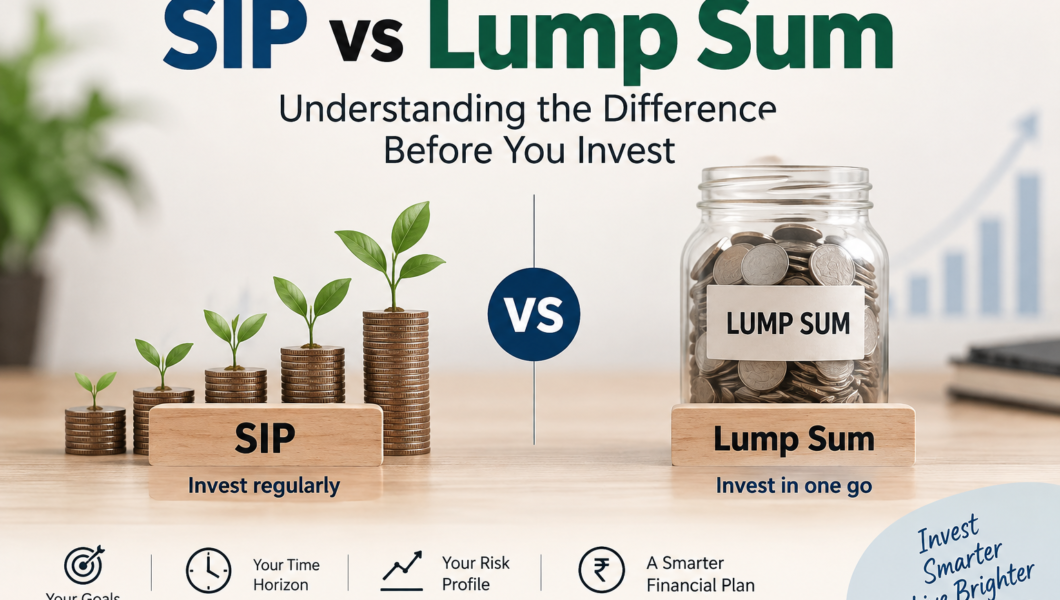
A Systematic Investment Plan (SIP) allows you to invest an amount periodically, while a lump-sum investment means investing an available amount in one go.
Neither method automatically makes a mutual fund safer or guarantees better returns. The more useful question is whether you have money available gradually from your regular income or already have a larger amount available to invest.
Let’s understand how both approaches work.
What Is a SIP?
A Systematic Investment Plan, commonly called SIP, is a facility for investing in a mutual fund at regular intervals.
For example, suppose you decide to invest ₹5,000 every month in a mutual fund.
Instead of manually making an investment every month, you can set up an SIP. Subject to the applicable mandate and scheme terms, the amount can then be invested periodically.
Importantly, SIP is not a separate investment product.
It is simply a method of investing in a mutual fund.
Your investment is still exposed to the risks of the underlying mutual fund scheme. If you use an SIP to invest in an equity mutual fund, for example, the investment remains subject to equity-market risk.
What Is a Lump-Sum Investment?
A lump-sum investment means investing an amount in a mutual fund in one transaction rather than spreading it across periodic SIP instalments.
For example, suppose you receive a ₹2 lakh annual bonus and decide that the entire amount is appropriate for a particular financial goal and mutual fund investment.
Investing the ₹2 lakh at one time would be a lump-sum investment.
Again, “lump sum” describes how you invest, not the type of mutual fund.
SIP vs Lump Sum: The Basic Difference
| Factor | SIP | Lump Sum |
|---|---|---|
| How money is invested | Periodically | In one transaction |
| Cash availability | Useful when money becomes available regularly | Relevant when a larger amount is already available |
| Purchase NAV | Investments happen at different applicable NAVs | Investment happens at the applicable NAV for that transaction |
| Units purchased | Vary with the NAV on each investment | Determined by the NAV applicable to the investment |
| Investing discipline | Can automate regular investing | Requires a decision when deploying additional available money |
| Market risk | Present | Present |
| Guaranteed return | No | No |
The choice between the two should therefore not be reduced to a simple question of which one gives “higher returns.”
How SIP Works When Markets Move
One of the important features of SIP investing is that the same investment amount can purchase different numbers of units at different NAVs.
Consider a simplified example.
Suppose you invest ₹5,000 per month.
| Month | Illustrative NAV | Approx. Units Purchased |
|---|---|---|
| Month 1 | ₹50 | 100.00 |
| Month 2 | ₹40 | 125.00 |
| Month 3 | ₹50 | 100.00 |
| Month 4 | ₹62.50 | 80.00 |
When the NAV is lower, the same ₹5,000 buys more units. When the NAV is higher, it buys fewer units.
This effect is commonly called rupee-cost averaging.
However, it is important not to misunderstand it.
Rupee-cost averaging does not guarantee a profit. It also does not protect an investor from losses when markets decline.
SIP simply spreads purchases across different dates and market levels.
SIP Does Not Eliminate Market Risk
A common misconception is:
“If I invest through SIP, I cannot lose money.”
That is incorrect.
Suppose an investor makes monthly SIP investments in an equity mutual fund and the equity market subsequently declines significantly.
The value of the accumulated investment can also fall.
Continuing to invest during lower NAV periods may result in the purchase of more units, but that does not guarantee that those units will subsequently rise in value or that the investor will earn a positive return.
The risk comes primarily from what you invest in—not simply whether you use SIP or lump sum.
An SIP into a high-risk mutual fund does not turn it into a low-risk investment.
What Happens With a Lump-Sum Investment?
With a lump-sum investment, the amount gets invested at one point rather than gradually through future instalments.
That means more of the investor’s money is exposed to the selected investment immediately.
Consider an investor with ₹3 lakh available for a long-term goal.
If the entire ₹3 lakh is invested today, the full amount participates in subsequent movements in the value of the investment.
If markets rise after the investment, the full invested amount participates in that rise.
If markets fall, the full invested amount is also exposed to that decline.
This creates an important difference from an SIP, where money that has not yet been invested is not exposed to that mutual fund.
But this observation should not be converted into a prediction about which method will perform better. Future market movements are unknown.
Is SIP Better When Markets Are Falling?
Not automatically.
During a falling market, an SIP can purchase progressively more units if NAVs decline while the SIP amount remains unchanged.
But investors cannot know in advance exactly when a decline will end, how quickly markets will recover, or what future returns will be.
Similarly, stopping an SIP merely because markets have fallen can turn a long-term investment plan into a market-timing decision.
The more relevant considerations are usually:
- Has your financial goal changed?
- Has your investment horizon changed?
- Has your ability to take risk changed?
- Is the selected mutual fund category still appropriate for the goal?
- Can you continue investing without affecting essential expenses and emergency savings?
Market direction alone should not replace a suitable financial plan.
Is Lump Sum Better When Markets Are Rising?
This is another question that is easy to answer only with hindsight.
If someone invests a lump sum immediately before a sustained market rise, investing earlier would have meant more money participated in that rise.
But an investor does not know beforehand whether the market will rise, fall or move sideways after the investment.
Waiting indefinitely for the “perfect” market level creates another risk: the money may remain uninvested while the investor tries to predict short-term market movements.
The decision should therefore begin with the purpose of the money, the time horizon, the selected asset class and the investor’s capacity to tolerate fluctuations.
The Bigger Question: Where Did the Money Come From?
This is one of the most practical ways to think about SIP versus lump sum.
When Money Becomes Available Every Month
A salaried person may not have several lakh rupees available today for a future goal.
Instead, ₹10,000 may become available for investment from each month’s income.
An SIP can match that cash flow naturally.
There is no need to accumulate twelve months of savings and wait until the end of the year merely to make a lump-sum investment.
When Money Is Already Available
The situation is different if an investor already has a substantial amount available—for example, from a bonus, maturity proceeds or accumulated savings.
In this case, choosing an SIP does not simply mean “investing regularly.”
It may mean deliberately keeping part of the available money outside the intended mutual fund and deploying it gradually.
That introduces additional questions:
Where will the uninvested money remain?
How long will deployment take?
Does delaying investment fit the financial goal and asset-allocation plan?
These questions are often more useful than asking which method has historically produced the highest return.
Example: Two Investors With Different Cash Flows
Consider two hypothetical investors.
Investor A: Investing From Monthly Salary
Investor A can save ₹15,000 every month toward a long-term financial goal.
Rather than waiting until ₹1.8 lakh accumulates at the end of a year, a monthly investment schedule may align naturally with the investor’s monthly cash flow.
Investor B: Already Has ₹1.8 Lakh
Investor B already has ₹1.8 lakh available.
The decision is different.
Investor B must decide whether the money should be invested immediately, deployed gradually, retained partly for near-term requirements, or allocated differently based on the financial plan.
These investors may ultimately invest the same total amount, but their starting situations are different.
That is why there cannot be one universal SIP-versus-lump-sum answer for everyone.
SIP Can Help With Investing Discipline
One practical advantage of SIP is automation.
Once the required instructions or mandate are in place, periodic investing can happen without requiring a fresh investment decision every month.
This can help an investor build a consistent investing habit.
It can also reduce the temptation to repeatedly postpone investing while waiting for a supposedly ideal market level.
But discipline should not be confused with guaranteed investment success.
A disciplined investment into an unsuitable asset or scheme can still produce an unsuitable outcome.
Investment selection, asset allocation, risk and time horizon remain important.
Common SIP vs Lump-Sum Mistakes
1. Believing SIP Guarantees Positive Returns
It does not.
Mutual funds are market-linked investments, and SIP does not eliminate the risks associated with the underlying scheme.
2. Choosing SIP Only Because the Market Looks Expensive
This turns the decision into a market-timing call.
Valuations can be relevant to investment decisions, but predicting short-term market movements consistently is difficult. The decision should not depend solely on a belief about where markets will move next.
3. Investing a Lump Sum Because the Market Recently Fell
A recent market decline does not tell you where the market will go next.
Investing solely because something has fallen can ignore asset allocation, suitability and the investor’s time horizon.
4. Keeping Emergency Money Invested for Better Returns
Before deciding between SIP and lump sum, identify whether the money is actually available for investment.
Money required for emergencies or near-term commitments may need different treatment from money intended for long-term investment.
5. Focusing on the Method but Ignoring the Fund
SIP versus lump sum is only one part of the decision.
An investor should also understand the scheme’s:
- investment objective,
- asset allocation,
- risk level,
- time horizon,
- costs,
- portfolio characteristics, and
- suitability for the intended goal.
A convenient investment method cannot compensate for an unsuitable investment.
6. Assuming More Units Mean More Wealth
A lower NAV allows the same investment amount to purchase more units, but the number of units alone does not determine investment success.
The eventual value depends on both the number of units held and their future NAV.
SIP or Lump Sum: Questions to Ask Before Deciding
Rather than asking, “Which one is better?”, consider asking:
Do I have money available periodically or is the amount already available today?
What financial goal is this investment meant for?
When will I need the money?
How much volatility can I reasonably tolerate?
What asset allocation is appropriate for the goal?
Is the mutual fund category suitable for that time horizon and risk requirement?
If I invest gradually, where will the remaining money stay in the meantime?
Am I choosing the investment method because of my financial plan—or because I am trying to predict the market?
Those questions put SIP and lump-sum investing in the correct context.
SIP vs Lump Sum: There Is No Universal Winner
SIP and lump sum are two ways of putting money into mutual funds.
An SIP may fit naturally when investible money becomes available periodically. A lump-sum investment may arise when money is already available for investment.
Neither method guarantees higher returns.
Neither removes market risk.
And neither should be chosen without considering the underlying investment, financial goal, investment horizon, risk capacity and overall asset allocation.
The objective should not be to discover a universally “better” investment method.
It should be to use an investment approach that fits your cash flow and financial plan without relying on predictions about what markets will do next.
Key Takeaways
- SIP is an investment facility, not a separate asset class or mutual fund product.
- SIP invests money periodically, while lump sum invests an available amount in one transaction.
- SIP can support regular investing and results in purchases at different NAVs.
- Rupee-cost averaging does not guarantee profits or prevent losses.
- Lump-sum investing exposes the invested amount to the selected investment from the time it is deployed.
- SIP does not make an unsuitable or risky mutual fund automatically suitable or safe.
- Trying to choose between SIP and lump sum based solely on predictions about market direction amounts to market timing.
- Cash flow, goals, time horizon, risk capacity and asset allocation are more useful starting points for the decision.
Frequently Asked Questions
Is SIP safer than lump-sum investing?
Not necessarily. SIP spreads investments over multiple dates, but the underlying mutual fund continues to carry its applicable risks. An SIP does not guarantee capital protection or positive returns.
Can I lose money in an SIP?
Yes. Mutual fund investments are subject to market risks. If the value of the underlying investments falls, the value of units accumulated through SIP can also decline.
Does SIP guarantee better returns than lump sum?
No. Their relative outcomes depend partly on the sequence of market movements and the timing of investments. Future market movements cannot be known in advance.
What is rupee-cost averaging?
When a fixed amount is invested periodically, it purchases more units when NAV is lower and fewer units when NAV is higher. This produces an average acquisition cost across investments. It does not assure a profit or protect against losses.
Should I stop my SIP when markets fall?
A market decline by itself does not determine whether an SIP should be stopped. Review the financial goal, investment horizon, cash flow, asset allocation, risk capacity and suitability of the investment rather than making the decision solely on short-term market movement.
Can I use both SIP and lump-sum investing?
They are simply different transaction methods. An investor may make periodic investments and may also invest additional available money, subject to the suitability of the investment and the investor’s financial plan.
Disclosure: GoMoneyCare is associated with mutual fund and insurance distribution. The content above is intended for investor education and general information and should not be treated as a recommendation of any particular mutual fund scheme or as personalised investment advice.
Mutual Fund Disclaimer: Mutual fund investments are subject to market risks. Read all scheme-related documents carefully before investing. Past performance does not guarantee future returns.
Read more about: Investing, Mutual Funds, Personal Finance, SIP


No Comments